
In The Style of the Summa
An argumentation for the Hopeful Mysteries "in the style of the summa"—provided by ChatGPT.

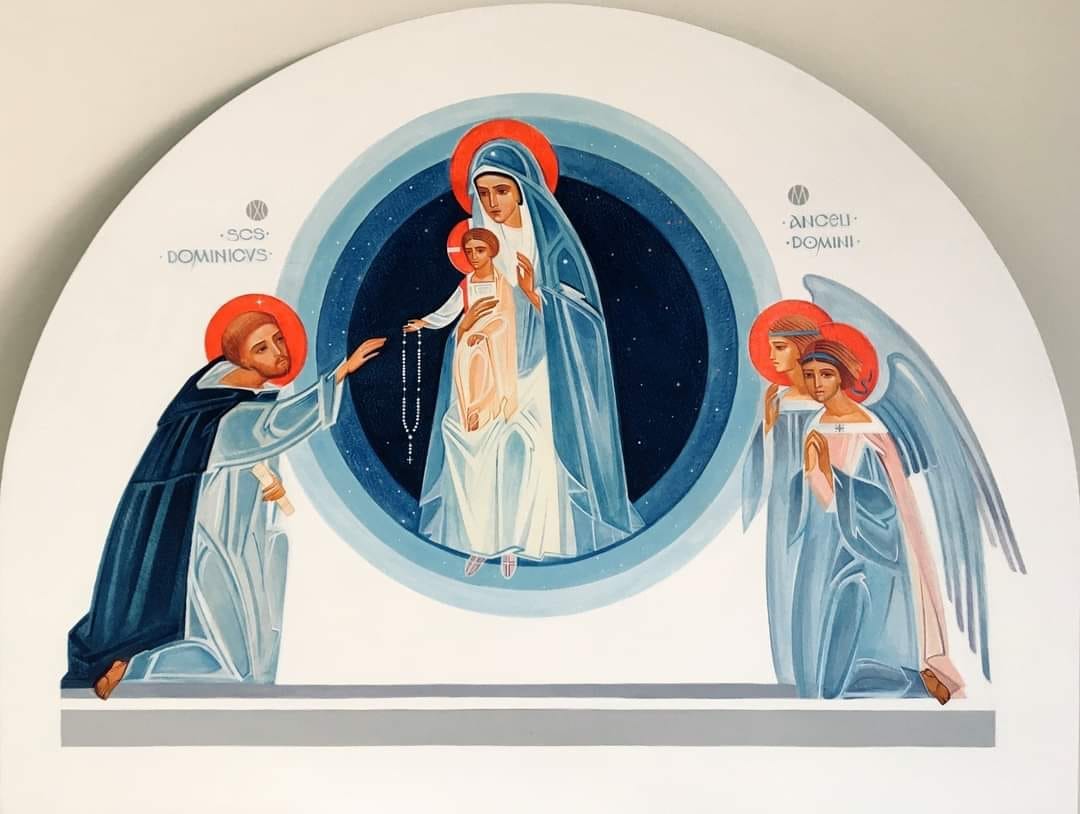
The Mysteries of Hope of the Rosary
Prologue
Since man journeys toward beatitude through the theological virtues, and hope sustains the soul amid trials, it is fitting that the Rosary should more explicitly contemplate this virtue. As faith enlightens the intellect and charity perfects the will, so hope fortifies the heart in awaiting divine promises. The Rosary, a means of meditative participation in Christ and His Blessed Mother, who is called "Mother of Hope," should reflect this reality.
Among the existing mysteries, faith and charity are explicitly represented, yet the exercise of hope, particularly in the hidden workings of divine providence, is less manifest. But devotion requires all aspects of Christian life to find their place in prayer. Since hope is perfectly exemplified in Holy Saturday's silence, when Christ rested in the tomb and the Blessed Virgin remained steadfast, the faithful should meditate upon this mystery.
Just as the Luminous Mysteries completed the contemplation of Christ’s public ministry, so the Hopeful Mysteries enrich the meditation upon the Paschal Mystery. These teach that grace works in expectation, that silence is not God’s absence but His hidden action, and that Christian hope, grounded in divine fidelity, is never in vain.
Question 1.
Fitness of the Hopeful Mysteries
We must now consider the fittingness of the Hopeful Mysteries in relation to the Rosary. Under this head, three points of inquiry arise:
Whether the Hopeful Mysteries are Theologically Necessary for the Completion of the Rosary's Contemplation of the Paschal Mystery?
Whether the Hopeful Mysteries Contribute to the Virtue of Hope in the Spiritual Life of the Faithful?
Whether the Individual Mysteries Proposed as the Hopeful Mysteries are Theologically Sound and Fitting for Devotional Practice?
Article 1.
Whether the Hopeful Mysteries are Theologically Necessary for the Completion of the Rosary's Contemplation of the Paschal Mystery?
Objection 1. It seems that the Hopeful Mysteries are not necessary for the completion of the Rosary’s contemplation of the Paschal Mystery. For the Rosary, as traditionally structured, already comprehensively covers the major events of Christ’s life, Passion, and Resurrection, and therefore, the addition of another set of mysteries is superfluous.
Objection 2. Further, Holy Saturday is a time of silence and hidden action, as the Church refrains from celebrating the Eucharist during the day, thereby emphasizing a lack of external activity. Therefore, it seems unfitting to introduce explicit meditations upon this time.
Objection 3. Moreover, the Rosary has been developed under the guidance of divine providence through centuries of tradition, and its structure as given—including the Joyful, Sorrowful, Glorious, and Luminous Mysteries—is already sufficient. Therefore, it is not fitting to introduce a new set of mysteries.
On the contrary, Pope St. John Paul II states in Rosarium Virginis Mariae that the Rosary is a “compendium of the Gospel” and should be open to development that deepens the faithful’s contemplation of the mysteries of Christ’s life. But the Paschal Mystery includes not only Christ’s Passion and Resurrection but also the silence and expectation of Holy Saturday. Therefore, it is fitting to incorporate the Hopeful Mysteries to complete this meditation.
I answer that, the Rosary is not merely a historical recounting of Christ’s life but a means by which the faithful enter into the mystery of salvation through prayerful meditation. Now, it belongs to the integrity of the Paschal Mystery that the silence of Holy Saturday be contemplated, for as the Church teaches, the whole process of redemption is not limited to Good Friday and Easter Sunday but includes the descent into the dead, the burial, and the expectation of new life.
Further, the virtue of hope is essential to Christian life, as St. Paul says, “In hope we were saved” (Romans 8:24). Yet among the existing mysteries of the Rosary, while faith and charity are explicitly represented in numerous events (e.g., the Annunciation for faith, the Crucifixion for charity), there is no explicit meditation on hope. Now, since Christ Himself, in His descent to the dead, in His rest in the tomb, and in the expectation of the Resurrection, exercised and manifested hope, it is fitting that these be contemplated in the Rosary.
Moreover, the theological tradition of the Church has considered Holy Saturday as a moment of eschatological significance, wherein Christ, in the silence of the tomb, proclaims victory over death, as attested to in 1 Peter 3:19: “He went and preached to the spirits in prison.” By introducing the Hopeful Mysteries, the faithful are led to meditate on the reality that even in waiting, God is at work, and thus they are strengthened in their own moments of suffering and uncertainty.
Therefore, it is fitting and necessary for the integrity of the Rosary’s meditation that the Hopeful Mysteries be included.
Reply to Objection 1. The Rosary, while already encompassing major moments of Christ’s life, does not explicitly include Holy Saturday or the virtue of hope. Since the Rosary is a living tradition, open to theological enrichment, the addition of these mysteries is not a redundancy but a deepening of its contemplation.
Reply to Objection 2. Silence does not mean absence, but rather hidden activity. As Pope Benedict XVI teaches in Spe Salvi, hope is active even when it is unseen. Holy Saturday, though silent, is a moment of profound divine action, and thus, its meditation is fitting.
Reply to Objection 3. The development of the Rosary in history—including the introduction of the Luminous Mysteries by St. John Paul II—demonstrates that theological reflection can enrich this devotion. Therefore, the addition of the Hopeful Mysteries follows a precedent already accepted by the Church.
Article 2.
Whether the Hopeful Mysteries Contribute to the Virtue of Hope in the Spiritual Life of the Faithful?
Objection 1. It seems that the Hopeful Mysteries do not contribute to the virtue of hope in the spiritual life of the faithful. For hope is already infused into the soul as a theological virtue, as St. Paul says, “Hope does not disappoint, because the love of God has been poured into our hearts” (Romans 5:5). Since the theological virtues are directly given by God and do not depend upon human meditation, it appears unnecessary to introduce new mysteries to cultivate hope.
Objection 2. Further, the virtue of hope is primarily directed toward eternal life, as stated in Summa Theologiae II-II, q. 17, a. 2: “Hope is the virtue by which we trust that we will attain eternal happiness through God’s help.” Now, the Rosary already contains meditations on eternal life, particularly in the Glorious Mysteries, which include the Resurrection, Ascension, and Coronation of Mary. Therefore, additional mysteries to foster hope are redundant.
Objection 3. Moreover, the theological tradition of the Church places greater emphasis on faith and charity, as St. Paul says, “The greatest of these is charity” (1 Corinthians 13:13). Since hope is the lesser of the theological virtues, it does not seem necessary to create a distinct set of mysteries to emphasize it.
On the contrary, Pope Benedict XVI, in Spe Salvi, teaches that “the one who has hope lives differently.” Yet, he laments that many Christians today experience an absence of hope. Therefore, a deepening of devotional practice to cultivate hope is necessary, and the Hopeful Mysteries contribute to this end.
I answer that, as St. Thomas teaches (Summa Theologiae II-II, q. 17, a. 1), “Hope is necessary for man in his present state of journeying towards beatitude.” Now, since Christian spirituality is ordered toward sanctification through meditation on divine mysteries, it is fitting that the virtue of hope be explicitly contemplated in the Rosary.
Hope is particularly tested in moments of suffering, waiting, and uncertainty. Now, the Hopeful Mysteries—such as the Burial of Christ, the Descent into Hell, and the Expectation of Mary—invite the faithful to meditate precisely on these moments where hope is required. This provides spiritual fortification, teaching that even in darkness, God’s promise is at work.
Further, the theological tradition affirms that the faithful are strengthened in virtue through repetition and contemplation, as St. Augustine says, “By constant meditation, we are made more disposed to divine things.” Since the Rosary serves as a repetitive meditation on salvation history, the addition of the Hopeful Mysteries directs the faithful’s attention to the virtue of hope in a structured and habitual manner.
Moreover, the Glorious Mysteries, while indeed focusing on eternal beatitude, do not explicitly contemplate the virtue of hope in its temporal dimension—that is, the hope required in times of suffering, silence, and trial. The Hopeful Mysteries remedy this by filling the experiential gap between Good Friday and Easter Sunday, allowing the faithful to enter spiritually into the hope that sustains the Church in times of waiting.
Therefore, the inclusion of the Hopeful Mysteries is fitting, as it serves to cultivate the theological virtue of hope in the spiritual life of the faithful.
Reply to Objection 1. While hope is infused by God, it must be exercised through human cooperation, just as charity is a gift yet must be practiced. The Rosary is a means of strengthening theological virtues, and thus, meditations specifically dedicated to hope are beneficial for its growth.
Reply to Objection 2. The Glorious Mysteries contemplate the fulfillment of hope but do not emphasize the experience of hope amid waiting and uncertainty. Since hope is exercised most profoundly in expectation rather than fulfillment, it is necessary to meditate on the virtue of hope through the events of Holy Saturday.
Reply to Objection 3. Although charity is the greatest of the theological virtues, St. Thomas teaches (Summa Theologiae II-II, q. 17, a. 8) that hope is essential for perseverance in charity. Therefore, strengthening hope through meditative prayer is not only beneficial but also necessary for a fuller spiritual life.
Article 3.
Whether the Individual Mysteries Proposed as the Hopeful Mysteries are Theologically Sound and Fitting for Devotional Practice?
Objection 1. It seems that the proposed Hopeful Mysteries are not theologically sound nor fitting for devotional practice. For the traditional mysteries of the Rosary are directly based on events explicitly narrated in Sacred Scripture, whereas some of the proposed Hopeful Mysteries—such as the Expectation of Mary—are not explicitly recounted in the Gospels. Therefore, it seems unfitting to introduce them into the Rosary.
Objection 2. Further, the inclusion of the Immaculate Conception within the Hopeful Mysteries disrupts the historical sequence of the Paschal events. For the Immaculate Conception pertains to the beginning of Mary’s earthly existence, whereas the other proposed mysteries take place between Good Friday and Easter Sunday. Therefore, this inclusion seems incongruous with the structure of the Rosary.
Objection 3. Moreover, the Rosary is a public devotion of the Church, and its mysteries have been historically recognized through magisterial approval, particularly through the Marian devotion of the Dominicans and the papal confirmation of the Luminous Mysteries by St. John Paul II. Since the Hopeful Mysteries have not received such universal approval, it is not fitting to promote them as part of the Rosary.
On the contrary, the Church has always allowed for the organic development of devotional practices in response to deeper theological reflection and the needs of the faithful. The Luminous Mysteries were introduced in the 21st century as a theological enrichment of the Rosary’s meditations. Likewise, the Hopeful Mysteries, which deepen the understanding of Holy Saturday and the virtue of hope, are fitting for inclusion.
I answer that, the mysteries of the Rosary serve as meditative aids to deepen one’s contemplation of the Paschal Mystery. Now, since theological reflection has long recognized Holy Saturday as an essential component of Christ’s work of redemption—wherein He rests in the tomb, descends into the dead, and prepares for the Resurrection—it is fitting to meditate on these aspects explicitly.
Moreover, each of the five proposed Hopeful Mysteries has strong theological foundations:
The Piercing of Christ’s Side – This mystery is explicitly recounted in John 19:34: “One of the soldiers pierced His side with a spear, and at once there came out blood and water.” The Church Fathers, particularly St. Augustine and St. John Chrysostom, interpret this as a moment of grace, symbolizing the birth of the Church through the sacraments of Baptism and the Eucharist. Since this event is deeply tied to the Paschal Mystery and is theologically rich, it is fitting for meditation.
The Immaculate Conception – Although it occurred chronologically before the Passion, it represents God’s providential preparation for redemption. Pope Pius IX, in Ineffabilis Deus, defines the Immaculate Conception as a singular grace given to Mary in view of Christ’s merits. Theologically, this aligns with Holy Saturday, which anticipates the Resurrection. Just as Holy Saturday is a time of hidden grace before visible victory, so too does the Immaculate Conception foreshadow Christ’s triumph.
The Burial of Christ – This mystery is explicitly mentioned in all four Gospels (cf. Matthew 27:57–61, Mark 15:42–47, Luke 23:50–56, John 19:38–42) and is affirmed in the Creed: “He was buried.” The burial of Christ represents the moment of profound silence before the Resurrection, inviting the faithful to meditate on God’s presence in suffering. Since this moment is deeply tied to Christian hope, it is fitting for inclusion.
The Descent of Christ into Hell – This mystery is affirmed in the Apostles’ Creed: “He descended into hell.” The Catechism of the Catholic Church (CCC 633) explains that Christ’s descent into the realm of the dead was part of His victory over sin and death. The Church Fathers, including St. Ignatius of Antioch, St. Irenaeus, and St. John Chrysostom, describe this as the moment when Christ liberates the souls of the righteous who had awaited redemption. Since this event directly concerns the hope of salvation, it is fitting for contemplation.
The Expectation of Mary – While not explicitly described in Scripture, this mystery is grounded in Marian theology. Lumen Gentium (no. 58) affirms Mary’s unwavering faith throughout Christ’s Passion and her union with Him in suffering. Just as the Church waits in hope for the Second Coming of Christ, Mary awaited the Resurrection in perfect trust. The Hispanic devotion to Nuestra Señora de la Esperanza (Our Lady of Hope) and the Byzantine tradition of The Hour of the Mother affirm the theological validity of this mystery.
Thus, the proposed Hopeful Mysteries are not arbitrary additions but theological developments that illuminate aspects of the Paschal Mystery not explicitly meditated upon in the existing Rosary structure. Since they deepen the understanding of Christ’s redemptive work and foster the virtue of hope, they are fitting for devotional practice.
Reply to Objection 1. The Rosary has never been limited to only direct scriptural events; rather, it also includes theological realities such as the Assumption of Mary, which is not explicitly stated in Scripture but is part of Church tradition. Since the Expectation of Mary is similarly rooted in theological tradition, it is fitting for inclusion.
Reply to Objection 2. The Immaculate Conception is included in the Hopeful Mysteries not as a chronological event but as a theological foundation. Just as the Rosary is not structured strictly in historical order (e.g., the Coronation of Mary occurs outside of time), the Immaculate Conception is fittingly included as a prefiguration of the redemption Christ brings.
Reply to Objection 3. While the Hopeful Mysteries have not yet received universal magisterial approval, the development of private devotions has historically preceded official recognition. The Luminous Mysteries, for example, were contemplated by various saints before being formally introduced. Likewise, the Hopeful Mysteries serve as a theological enrichment that may develop into a recognized part of Marian devotion.
This text appears in its entirety in a document (which will probably remain in constant update for now), created with the help of ChatGPT, where I try to encapsulate all I’ve written here plus what I’ve read about subjects related to the Hopeful Mysteries; it’s attached below.
